

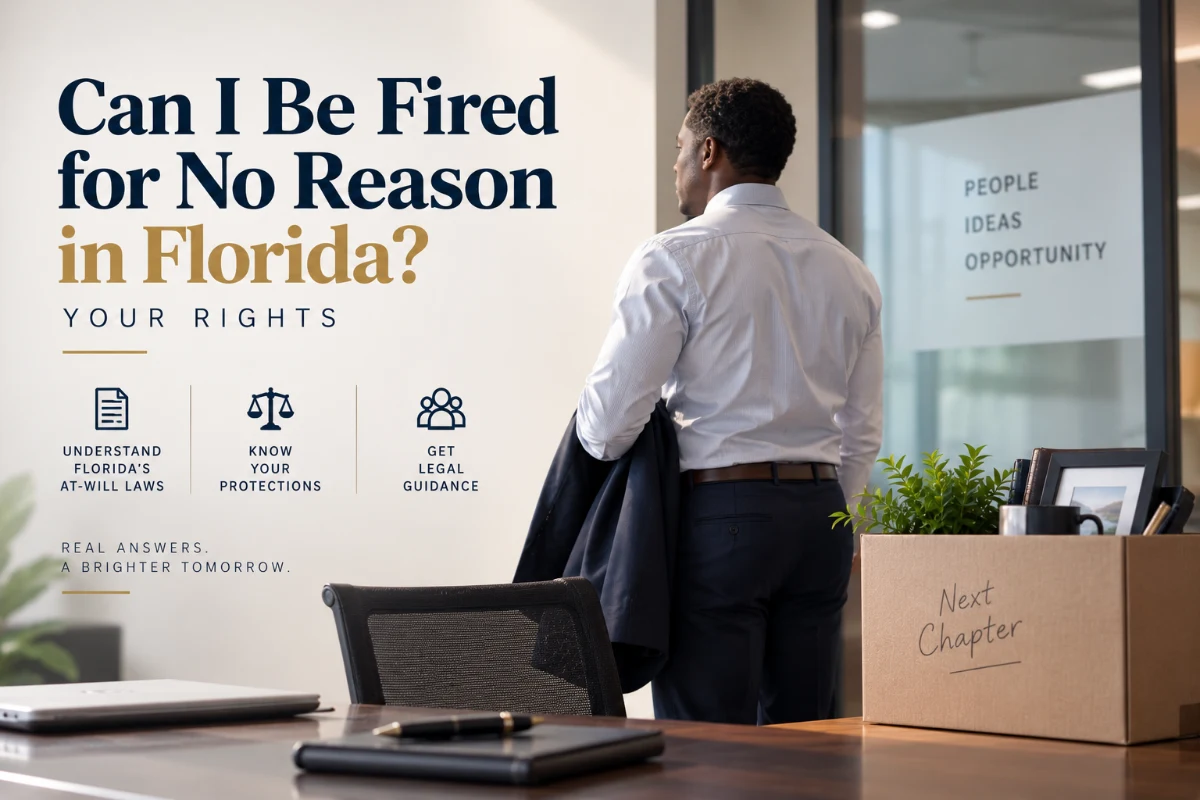
Yes — in Florida, your employer can usually fire you for no reason at all, without warning, and without telling you why. Florida is an “at-will” state, so a boss can let you go for a good reason, a bad reason, or no reason. But there’s a critical exception most people don’t know: your employer cannot fire you for an illegal reason. If the real reason was your race, sex, age, disability, pregnancy, or because you complained about something unlawful, “no reason” is often a cover story — and that firing may be against the law. Here’s how to tell the difference, the deadlines that matter, and what to do next.
What “at-will employment” really means in Florida
At-will employment means that, absent a contract saying otherwise, either you or your employer can end the job at any time. Your employer doesn’t owe you a warning, a written explanation, a severance package, or a second chance. Being fired “out of the blue” or “without cause” is, by itself, usually legal in Florida.
That sounds harsh, and it often feels deeply unfair. But at-will has real limits. Federal and Florida law carve out categories of firings that are never allowed, no matter how “at-will” your job was. The question that actually matters is not “did my employer give a reason?” — it’s “was the true reason an illegal one?”
When being fired for “no reason” is actually illegal
An employer will rarely admit the real motive. Instead, you’ll hear “it’s just not working out,” “we’re restructuring,” or nothing at all. The law looks past the label to what really drove the decision. A firing crosses the line into illegal territory when it’s based on any of the following:
Discrimination. Your employer cannot fire you because of a protected characteristic. Under Title VII, the Age Discrimination in Employment Act, the Americans with Disabilities Act, and the Florida Civil Rights Act, that includes race, color, national origin, sex (including pregnancy, and — under the Supreme Court’s Bostock decision — sexual orientation and gender identity), religion, age 40 or older, disability, and marital status. Most of these laws apply to employers with 15 or more employees (20 or more for age claims).
Retaliation. This is one of the most common — and often strongest — claims employees bring. Your employer cannot fire you for exercising a legal right: reporting discrimination or harassment, filing or supporting a complaint, requesting a disability or pregnancy accommodation, or cooperating in an investigation. Even if the underlying complaint doesn’t succeed, punishing you for making it in good faith is separately illegal.
Taking protected leave. Under the federal Family and Medical Leave Act, eligible employees at covered employers can take job-protected leave for a serious health condition or a new child. Firing you for using — or asking about — that leave can be unlawful interference or retaliation.
Whistleblowing. Florida’s private-sector Whistleblower Act protects employees who object to, or refuse to participate in, an activity that violates the law, or who report a legal violation. You generally cannot be fired for refusing to break the law for your boss.
Filing a workers’ compensation claim. Florida law specifically prohibits firing or punishing an employee for filing or pursuing a valid workers’ comp claim after a workplace injury.
Serving on a jury, and other public duties. Florida law bars an employer from firing you for responding to a jury summons and serving.
Breaking a contract. If you have an employment contract, or you’re covered by a union collective bargaining agreement, at-will may not apply to you at all — your firing has to follow the terms you were promised.
If any of these fits your situation, “no reason” may really mean “a reason they can’t say out loud.”
Signs your “no reason” firing may not be legal
Timing and pattern usually tell the story. Warning signs worth a closer look include:
You were fired shortly after you reported harassment or discrimination, asked for an accommodation, or filed a complaint. You were let go soon after your employer learned you were pregnant, disabled, or a certain age. You had a clean record until you raised a concern, then suddenly got written up. You were replaced by someone younger, or outside your protected group. Or you were treated more harshly than coworkers who did the same thing but don’t share your protected characteristic.
None of these alone proves a case. Together, they’re exactly the kind of circumstantial evidence an employment lawyer uses to show the stated reason was a pretext — a cover for an illegal one.
What evidence helps
If you believe your firing wasn’t really about “nothing,” start protecting the proof now:
Save any emails, texts, or messages about your complaint, your accommodation request, or the firing itself. Request a copy of your personnel file, and keep your termination notice and recent performance reviews. Write down a dated timeline — what you reported, to whom, and what happened afterward. Note coworkers who witnessed events or were treated differently. And keep pay stubs and benefits records to help show your losses. Store copies on a personal device or email, not just your work account, which you can lose access to overnight.
Deadlines that matter — and a new Florida law you should know about
Employment claims run on strict clocks, and missing one can end an otherwise strong case. In Florida:
To pursue a federal discrimination or retaliation claim, you generally must file a charge with the EEOC within 300 days of the wrongful act. To pursue a Florida Civil Rights Act claim, you generally must file with the Florida Commission on Human Relations (FCHR) within 365 days. You usually have to file one of these charges before you can sue.
As of July 1, 2026, a new Florida law (CS/HB 1407) clarifies how long you then have to actually file a lawsuit under the Florida Civil Rights Act — an issue that had caused years of confusion in the courts. In general terms, once the FCHR issues a cause determination or the EEOC issues a Notice of Right to Sue, the deadline to file suit is tied to that event; and if the agencies don’t act within 180 days of your charge, a separate outer deadline applies. The details are technical and fact-specific, which is exactly why it’s worth having an attorney confirm your personal deadline rather than guessing.
Other claims — whistleblower, workers’ compensation retaliation, unpaid wages — carry their own separate deadlines. Because several clocks can run at once, the safest move is to talk to a lawyer early.
What to do next
Losing your job without warning is frightening, especially when you suspect the real reason was something your employer would never put in writing. You don’t have to figure this out alone. A short, confidential conversation with an employment lawyer can tell you whether your firing was actually legal, what your case might be worth, and which deadline applies to you — before the clock runs out. There’s no cost to find out where you stand.
Can my employer fire me for no reason in Florida?
Usually yes — Florida is an at-will state, so an employer can fire you without warning or explanation. But they cannot fire you for an illegal reason, such as your race, sex, age, disability, pregnancy, or because you complained about unlawful conduct.
Does my employer have to tell me why I was fired in Florida?
No. Florida law does not require an employer to give a reason for a termination. But a missing or shifting explanation can sometimes be evidence that the real reason was an illegal one.
Is being fired without warning the same as wrongful termination in Florida?
Not by itself. Wrongful termination in Florida generally means a firing for a legally prohibited reason — discrimination, retaliation, or another protected category — not simply a firing that feels unfair or was a surprise.
How long do I have to take action after being fired in Florida?
Generally 300 days to file a charge with the EEOC for federal claims, and 365 days to file with the Florida Commission on Human Relations for Florida claims. A new Florida law effective July 1, 2026 clarifies the deadline to then file a lawsuit, so it is best to confirm your specific dates with an attorney quickly.
What should I do if I think I was fired illegally in Florida?
Preserve your evidence — emails, texts, your personnel file, and a written timeline — and speak with an employment lawyer before a filing deadline passes. WLT Law Firm offers a free, confidential consultation for Fort Lauderdale and Broward County employees — call 954-905-9863.
Related: If you were let go, learn how we help with wrongful termination, workplace retaliation, and employment discrimination in Florida. You can also meet with us at our Plantation office.
This article is general information about Florida and federal employment law, not legal advice. Every situation is different — speak with a qualified attorney about your specific circumstances.