

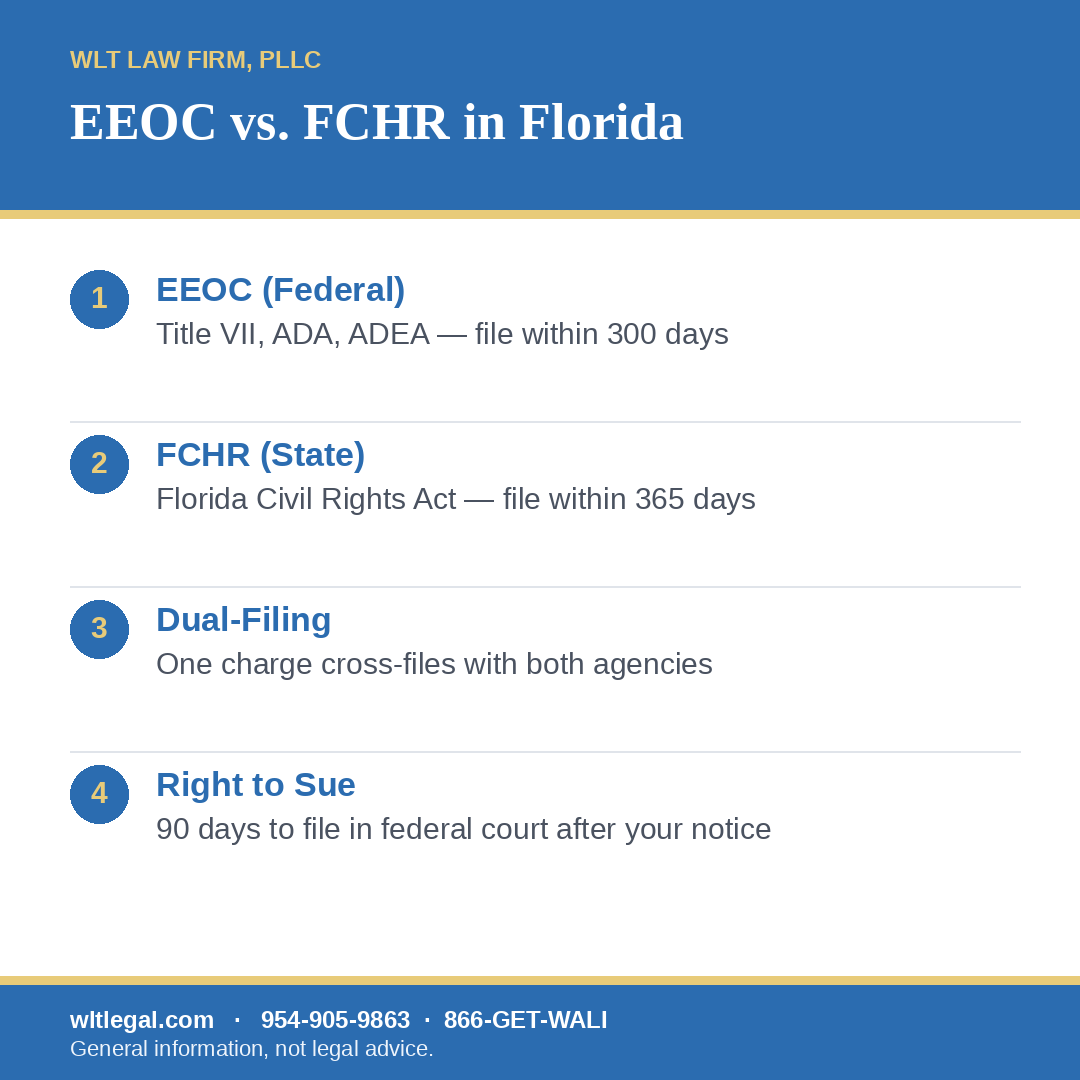
If you were discriminated against, harassed, or retaliated against at work in Florida, you have two agencies you can turn to: the EEOC (the federal Equal Employment Opportunity Commission) and the FCHR (the Florida Commission on Human Relations). Here’s the short answer most people are looking for: in Florida you usually don’t have to choose. Because the two agencies share a work-sharing agreement, filing with one automatically cross-files with the other — so a single, timely charge protects both your federal and your state rights. The details still matter, though, because the deadlines and the money you can recover are different. Below is the simple breakdown, from an employment law perspective.
What is the EEOC, and what does it cover?
The EEOC is the federal agency that enforces the national anti-discrimination laws. When your claim arises under federal law, you file a document called a Charge of Discrimination with the EEOC.
The main federal laws the EEOC enforces include Title VII of the Civil Rights Act (race, color, religion, sex, and national origin), the Americans with Disabilities Act (ADA), the Age Discrimination in Employment Act (ADEA, for workers 40 and older), and the Genetic Information Nondiscrimination Act (GINA). Title VII and the ADA generally apply to employers with 15 or more employees; the ADEA applies to employers with 20 or more.
What is the FCHR, and what does it cover?
The FCHR is the Florida state agency that enforces the Florida Civil Rights Act (FCRA), found in Chapter 760 of the Florida Statutes. The FCRA is Florida’s state-law counterpart to Title VII and covers many of the same protected categories — race, color, religion, sex, pregnancy, national origin, age, disability, and marital status.
When your claim arises under state law, you file a complaint with the FCHR. In practice, most Florida workplace discrimination situations violate both federal and state law at the same time, which is exactly why the two agencies coordinate.
EEOC vs. FCHR: do I have to pick one?
This is a question we hear a lot, and the reassuring answer is no — you generally do not have to gamble on the “right” agency. Florida has a work-sharing agreement between the EEOC and the FCHR. Under that agreement, a charge filed with either agency is treated as dual-filed with the other, as long as you file within the deadlines.
That said, you should never assume the cross-filing happened. The safest practice is to file with the EEOC, expressly request dual-filing with the FCHR, and confirm both agencies received it. An experienced attorney will make sure both boxes are checked so a paperwork gap never costs you a claim.
The deadlines: 300 days vs. 365 days (this is where people get hurt)
Missing a filing deadline is the single most common way a strong case gets thrown out before anyone ever looks at the real facts. The two agencies run on different clocks:
- EEOC — 300 days. In Florida you get 300 days from the discriminatory act to file your federal charge (not the 180 days you’ll see quoted for some other states). Florida gets the longer window because it is a “deferral state” with its own agency, the FCHR.
- FCHR — 365 days. The Florida Civil Rights Act gives you 365 days from the violation to file your state charge.
Here’s the catch that surprises people: if you dual-file, the shorter 300-day federal clock is the one that effectively controls the protection of both claims. In other words, don’t rely on the extra 65 days — treat 300 days as your real deadline. The clock starts on the date of the adverse action (for example, the day you were fired or demoted), not the day you finally decide to do something about it.
After the agency: the right-to-sue clock and the new 2026 rule
Filing the charge is the beginning, not the end. To take a federal discrimination claim to court, you first need a Notice of Right to Sue from the EEOC — and once you receive it, you have just 90 days to file your lawsuit. That 90-day deadline is enforced strictly, so it should go on the calendar the moment the letter arrives.
On the state side, there’s a fresh development worth knowing about. Florida’s CS/HB 1407 took effect July 1, 2026, and it clarified the timeline for filing an FCRA lawsuit in state court — generally tied to a one-year window measured from the earlier of the FCHR’s reasonable-cause finding or the EEOC’s right-to-sue notice. If neither agency acts within 180 days of your complaint, the deadline is 18 months from the date you filed it. The exact dates that apply to your situation depend on your specific facts, so confirm them with an attorney rather than counting days on your own — but the key takeaway is that Florida now offers clearer state-court timing than it did a year ago.
Does it matter for the money? EEOC vs. FCHR damages
The agency you file with is really about which laws protect you — and the different laws allow different remedies. This is one reason it’s usually smart to preserve both the federal and state claims rather than only one:
- Federal (Title VII/ADA): compensatory and punitive damages are capped based on employer size, ranging from $50,000 (smaller employers) up to $300,000 (the largest). Back pay and front pay are separate and are not subject to those caps.
- State (FCRA): there is no dollar cap on compensatory damages (things like emotional distress and loss of dignity), while punitive damages are capped at $100,000. Claims against government employers carry their own overall limits.
Because federal and state law each have strengths, keeping both alive through dual-filing typically gives you the most flexibility later. In race and national-origin cases in particular, there are additional federal claims (such as those under 42 U.S.C. § 1981) that don’t even require an agency charge and carry no damages cap — another reason to have your options reviewed early.
What to do next
If you think you were treated illegally at work, the most important thing is not to let the deadline run. Here’s a simple path:
- Write down the date of the adverse action (firing, demotion, pay cut, denied accommodation) and any earlier complaints you made.
- Save your evidence — emails, texts, pay stubs, performance reviews, and the names of anyone who saw what happened.
- Talk to an employment lawyer before you file. How the charge is drafted — which boxes you check and how the story is told — can preserve or accidentally waive entire claims and theories.
You do not have to figure out the EEOC-versus-FCHR question by yourself, and you do not have to pay anything upfront to get answers. Most employment cases are handled on a contingency basis, and in many discrimination cases the employer can be ordered to pay your attorney’s fees if you prevail.
Frequently asked questions
Is it better to file with the EEOC or the FCHR in Florida?
For most Florida workers, the practical answer is to file with the EEOC and request dual-filing with the FCHR, so both your federal and state claims are preserved at once. The right approach depends on your specific claim, employer, and goals — an attorney can confirm the best route for you.
What is the deadline to file an employment discrimination charge in Florida?
Generally 300 days for a federal (EEOC) charge and 365 days for a state (FCHR) complaint, measured from the date of the discriminatory act. If you dual-file, treat the 300-day clock as your real deadline.
Does filing with one agency automatically file with the other?
Usually yes — Florida’s EEOC/FCHR work-sharing agreement treats a charge filed with one as dual-filed with the other. Still, confirm both agencies received it rather than assuming.
How long do I have to file a lawsuit after the agency finishes?
For federal claims, 90 days from receiving your EEOC Notice of Right to Sue. For state FCRA claims, Florida’s timing was clarified by CS/HB 1407 (effective July 1, 2026) — generally one year from the earlier of the FCHR’s reasonable-cause determination or the EEOC’s Notice of Right to Sue — or, if neither agency acts within 180 days, 18 months from the date you filed the complaint. Confirm your exact dates with counsel.
Do I need a lawyer to file with the EEOC or FCHR?
You can file on your own, but how the charge is written affects what claims you can later bring in court. A short, free consultation before you file is the safest move.
Talk to a Fort Lauderdale employment discrimination lawyer — free and confidential. If you’re facing discrimination, harassment, or retaliation anywhere in Broward County or across South Florida, WLT Law Firm can help you protect your rights before a deadline passes. Call us at 954-905-9863 or toll-free at 866-GET-WALI (866-438-9254) for a free, confidential consultation.
This article is general information about Florida and federal employment law, not legal advice. Every situation is different — speak with a qualified attorney about your specific circumstances.